Variables & Connections
Leoflow stores Variables and Connections in the control plane (connection secrets encrypted at rest, AES-256-GCM — ADR 0019) and delivers them to task pods at runtime as environment variables, so your task reads them with the native Airflow APIs and as plain env (ADR 0021).
Tenancy
Tenancy is single-tenant on Lite; Pro adds multi-tenant isolation. The agent injects the current tenant's Variables/Connections per ADR 0019.
Manage them
Via the Airflow-compatible UI (Admin → Variables / Connections) or the API:
# Variable
curl -X POST "$LEOFLOW_SERVER/api/v2/variables" -H "Authorization: Bearer $TOKEN" \
  -H 'Content-Type: application/json' -d '{"key":"greeting","value":"hello"}'

# Connection (password + extra are encrypted at rest)
curl -X POST "$LEOFLOW_SERVER/api/v2/connections" -H "Authorization: Bearer $TOKEN" \
  -H 'Content-Type: application/json' \
  -d '{"connection_id":"warehouse","conn_type":"postgres","host":"db","login":"u","password":"p","schema":"analytics"}'
In the UI: connection types & editing
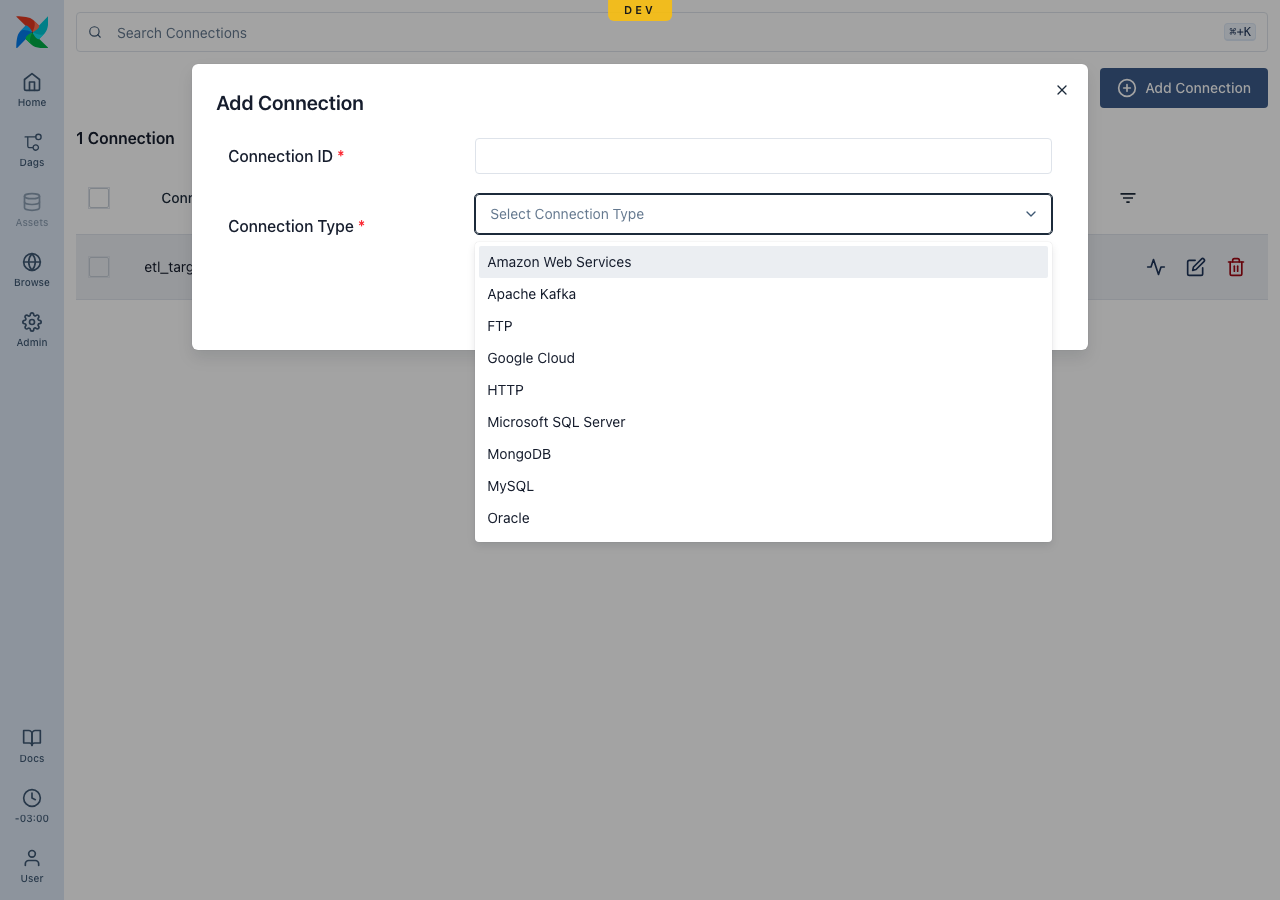
The Admin → Connections form offers a catalog of common connection types (borrowed from Airflow's providers — Postgres, MySQL, HTTP, AWS, Google Cloud, Snowflake, Redis, SSH, …); pick one and edit the fields it needs.
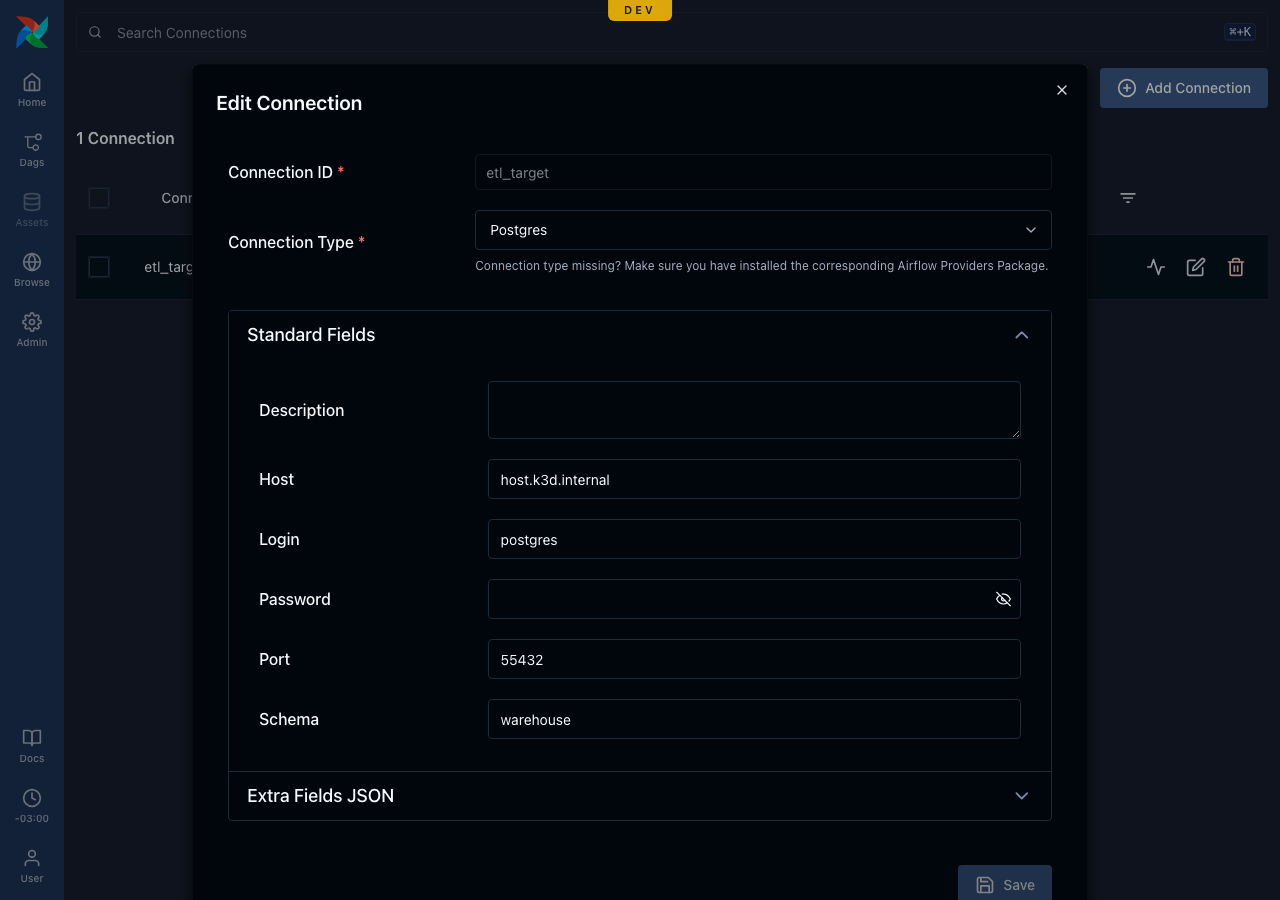
The form renders the standard fields for the chosen type (host, login, password, port, schema, description) plus an Extra JSON block, and an existing connection opens pre-filled (the password is write-only and never returned):
Test a connection
The Test button (POST /api/v2/connections/test) checks the endpoint's
reachability from the control plane — an HTTP(S) request, or a TCP dial to
host:port (the type's well-known port when none is set) — and returns
{status, message}. Note this tests from the control plane, not the task pod, so
a host only resolvable inside the cluster (e.g. host.k3d.internal in dev) reads
as unreachable there even though pods can reach it. Full per-provider credential
validation needs the provider hooks (a later addition).
Read them in a task
The agent injects each tenant's Variables/Connections before running your code:
AIRFLOW_VAR_<KEY>(uppercased) →Variable.get("key")AIRFLOW_CONN_<ID>(a connection URI, withextracarried under__extra__) →BaseHook.get_connection("id")
from airflow.sdk import task

@task
def use_secrets():
    import os
    from airflow.sdk import Variable          # native Airflow API
    print(Variable.get("greeting"))           # "hello"
    print(os.environ["AIRFLOW_VAR_GREETING"]) # also a plain env var
Scope is global (per tenant). Delivery requires a secure agent channel (TLS, #58)
or, in dev, the explicit LEOFLOW_AGENT_ALLOW_INSECURE_SECRETS=true (set by
leoflow lite). Pro on Kubernetes (including GKE) requires TLS — the chart
ships agentTLS.enabled: true by default and the server refuses the insecure
bypass; the plaintext escape hatch is Lite-only, for local iteration. See
ADR 0021.